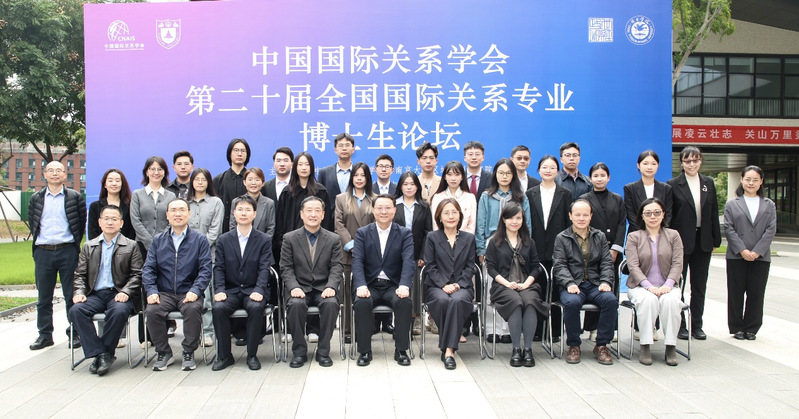
On October 20, 2025, the “20th National Doctoral Forum on International Relations of China National Association For International Studies” was successfully convened at Xianlin Campus of Nanjing University.
The forum was co-hosted by China National Association for International Studies, Nanjing University Institute of Area Studies, the editorial office of Nanjing University Area Studies Review, World Economics and Politics and Foreign Affairs Review.
The event facilitated academic exchanges on the theme “New Topics, Methods, and Trends on International Relations Theory and Area Studies”.
Twenty Doctoral students from Peking University, Tsinghua University, Fudan University, Renmin University of China, Nanjing University, and China Foreign Affairs University, presented their research papers. Prof. Chen Yunsong, Vice Chancellor of Nanjing University; Professor Sun Jisheng, Secretary-General of China National Association For International Studies and Vice President of China Foreign Affairs University; Dr. Li Junyang, Deputy Director and Associate Research Fellow of the editorial office of World Economics and Politics at the Institute of World Economics and Politics, Chinese Academy of Social Sciences, attended the opening ceremony and delivered speeches.
Prof. Wang Yizhou, Dean of Nanjing University Institute of Area Studies, gave a keynote speech. Ling Shengli, Deputy Secretary-General of China National Association for International Studies and Director of Department of Academic Research at China Foreign Affairs University, presided over the opening ceremony.
Chen Yunsong, Vice Chair of the CPC Council of Nanjing University, indicated that Nanjing University consistently adheres to the guidance of Xi Jinping Thought on Diplomacy and Culture, regarding Area Studies as crucial means to serve major-country diplomacy with Chinese characteristics in the new era and to promote exchanges and mutual learning of civilizations. He expressed that in the study of International Relations and Area Studies, doctoral students would persist in unifying China perspective and global vision, promote interdisciplinary and methodological integration, combine theoretical innovation with practical orientation, advancing the study of International Relations theory and Area Studies with Chinese characteristics to a higher level.
Prof. Sun Jisheng noted that since the beginning of the first National Doctoral Forum on International Relations held in 2006, it has been held for the 20th time and become a significant brand in China's International Relations academia, which has witnessed the vigorous development of International Relations in China. The forum demonstrates research perspectives and awareness of issues among doctoral students. She encouraged students to base their research on national demand while keeping global trends, enhance the foresight in agenda-setting, consciousness of methodology, and originality in analytical perspectives, and contribute to the advancement of academic research and discipline development in International Relations.
Prof. Li Junyang expressed that the journal World Economics and Politics has always attached great importance to young scholars and has been deeply involved in the National Doctoral Forum on International Relations. A long-lasting, positive, and mutually reinforcing symbiotic relationship has been formed between the journal and young scholars, and shaping the boundaries of the discipline historical changes. She looked forward to the forum continuing to yield outstanding research outputs and guiding the development of the field.
Prof. Wang Yizhou pointed out that against the backdrop of accelerating change on a scale unseen in a century, the discipline of International Relations is also undergoing a significant transformation. This involves the “creative destruction” of traditional disciplines and topics, as well as the emergence of new disciplines achieving subjectivity and branching out. Within this transformative process, Area Studies shapes the world through regions and propels new paradigms in the International Relations academia. He encouraged young scholars to seize the opportunities of the era, engage in learning and innovation actively, design new research agendas independently, explore new frontiers courageously, cultivate academic niches precisely, attempt interdisciplinary research boldly, and ultimately develop distinctive, diverse, and flourishing research characteristics and patterns.
The 20 authors of the selected papers engaged in exchanges across several panels: Discourse and Alliance, Theory and Issues, Security and Strategy, Area Studies, Regional Cooperation and Global Governance. Experts from Tsinghua University, Renmin University of China, Nanjing University, Shanghai Jiao Tong University, China Foreign Affairs University, and the Chinese Academy of Social Sciences provided deep and meticulous comment on papers.
(Trans./Wei Yawen)