On Tuesday, October 21, 2025, Prof. James Laurenceson, Dean of the Australia-China Relations Institute at the University of Technology Sydney, was invited to visit the School of International Studies at Nanjing University.
He delivered an academic lecture titled The Structural Stabilization and Future Trends of Contemporary Australia-China Relations. The lecture was chaired by Ma Bo, Associate Professor of the School of International Studies.
Li Lingqun, Associate Professor, and Li Tu, Assistant Professor of the School of International Studies, along with more than 30 faculty members and students attended the lecture.
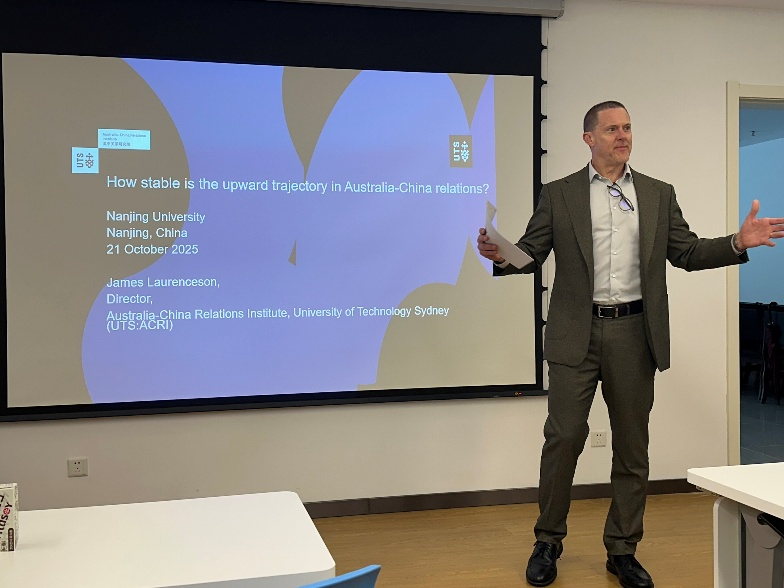
Prof. Laurenceson pointed out that since 2022, Australia-China relations have shown structural improvement after several years of downturn. This progress is not accidental but represents a realistic stabilization based on common interests, domestic political consensus, and the recognition of a multipolar global landscape. He emphasized that although Australia is a security ally of the United States, it maintains closer economic and social ties with China, and bilateral cooperation has a solid foundation. Currently, Canberra increasingly acknowledges the trend of global multipolarity in its strategic outlook, refuses to view China as a threat, and advocates for promoting security and stability through economic and trade interdependence.
He further noted that Australian societal attitudes towards China are becoming more rational, with bipartisan support for deepening economic and trade cooperation. Simultaneously, trust in the United States is undergoing a rational cooling.
Prof. Laurenceson believes that Australia-China relations are entering a new stage characterized by pragmatism, steadiness, and sustainability.
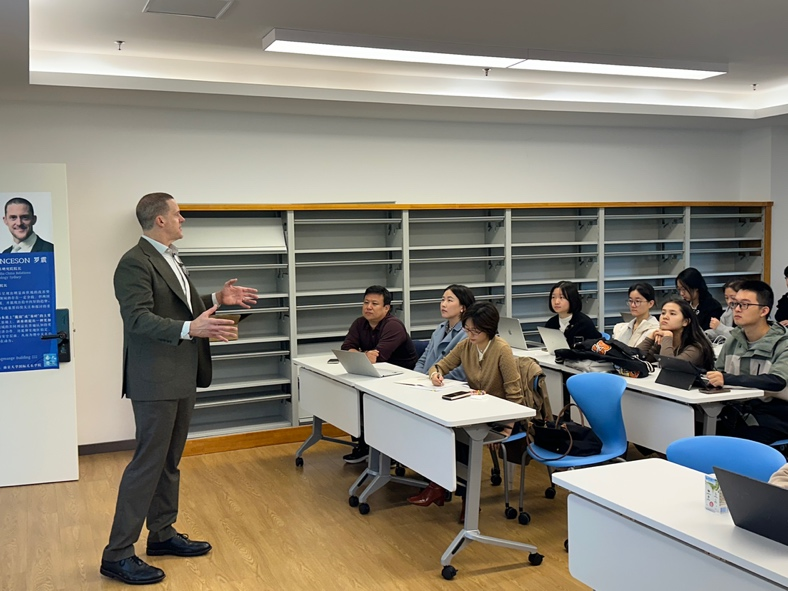
During the Q&A session, Prof. Laurenceson provided in-depth responses to issues including rare earth and electric vehicle supply chains, the interplay between economic interdependence and security relations, societal perceptions, and future variables. He stated that Australia will adhere to a resource policy of diversification without decoupling, seeking to jointly manage risks rather than engage in confrontation amid U.S.-China competition. While economic interdependence cannot completely eliminate security competition, it can effectively reduce the risks of miscalculation and the costs of conflict, serving as a rational security mechanism. He also called for strengthened exchanges and cooperation between academic circles and the younger generations of China and Australia to dispel stereotypes at the societal level.
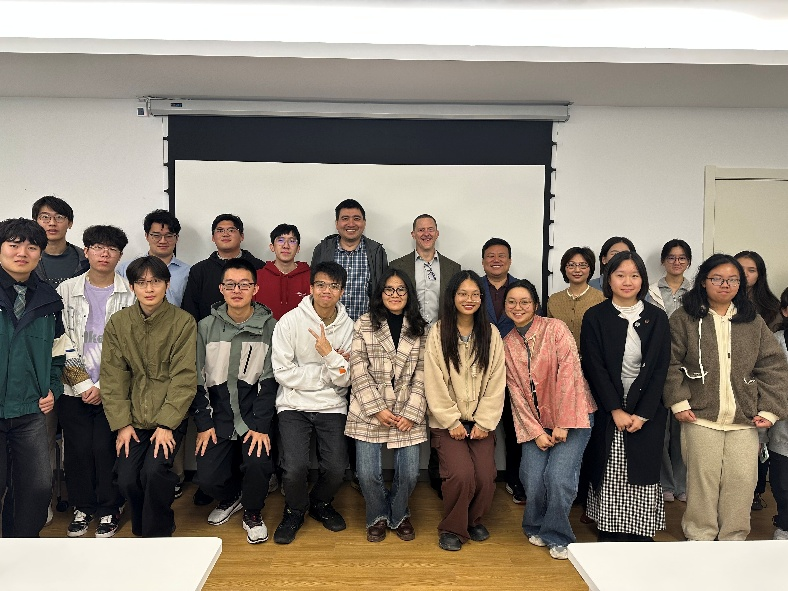
After the lecture, Prof. Laurenceson engaged in a warm exchange and took photos with faculty and students of the School of International Studies.
On behalf of the School, Dean Li Yuehua presented a souvenir to Prof. Laurenceson. The two sides held in-depth discussions on matters of mutual interest, such as future collaboration in think tank partnerships, the establishment of faculty and student exchange mechanisms between the School of International Studies and the Australia-China Relations Institute, and joint training programs to support Jiangsu enterprises in going global.
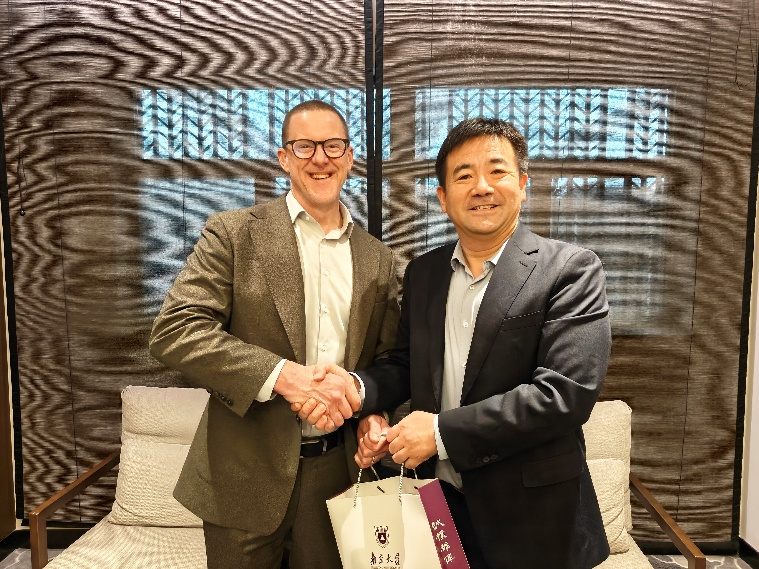
Both sides agreed that this visit served not only as an opportunity for academic exchange but also coincided with the important juncture of Nanjing University's comprehensive advancement of its Global Strategy (2020-2030). Against this backdrop, they expressed hope to use this exchange as a starting point to build long-term, practical, and trustworthy cooperative mechanisms in the fields of academic research and policy dialogue. The aim is to elevate the intellectual contribution of Australia-China relations research to the level of solution generation. This effort is intended to facilitate higher-level, broader, and deeper cooperation between Chinese and Australian universities, thereby providing solid academic and policy support for the healthy, stable, and sustainable development of Australia-China relations.
(Text/Zhao Wenhan; Photos/Cheng Zijia; Trans./Wei Yawen)